Painting Nature in Jahangir’s Empire
- Aaniya Aizaz

- 7 days ago
- 3 min read
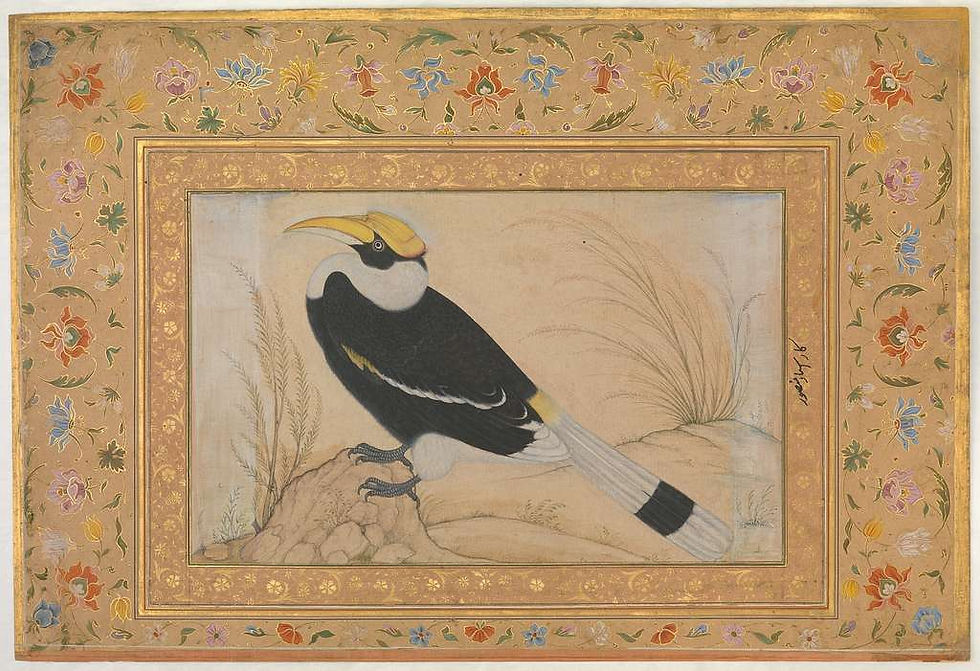
In the early 1600s, the Mughal court refused to treat nature as mere background scenery. Under Jahangir, animals, birds, and plants became subjects in their own right, worthy of the same attention once reserved for princes and saints.
The reason is unusually traceable: Jahangir wrote obsessively about the natural world in his memoir, the Jahangirnama, and he repeatedly describes a method that modern practices can trace back their genealogy to.
First, observe closely. Then preserve what was seen by ordering artists to make faithful “likenesses” of creatures he considered rare, striking, or unfamiliar.
That word, likeness, matters. These images were not only decorative. They functioned as records. They proved that the imperial court had encountered the world’s beautiful strangeness up close, and that it had the skill to pin it down on paper with calm precision. This strangeness mustn’t be taken for distaste, but an awe for what was once out of reach now adorned the walls of the court.
This project took shape inside the imperial atelier, and artists such as Ustad Mansur became famous for natural history studies so exact that they read like portraits.

A good example is Ustad Mansur’s study of a nilgai, which the Metropolitan Museum of Art links to direct observation, likely in Jahangir’s zoological garden.
The animal is rendered with the seriousness Mughal artists usually reserved for elite sitters: measured stance, careful musculature, attention to coat and expression, and a sense of presence rather than mere ornament. The ambition was not limited to local wildlife.

Jahangir’s court sat inside global circuits of gifts, diplomacy, and trade, and exotic animals often arrived as political theatre. Ustad Mansur’s zebra painting, dated to 1621, is one of the most famous examples.
The zebra reached the Mughal court through Ethiopian and intermediary networks, and the painting carries an inscription associated with Jahangir that describes its arrival and credits Mansur with the likeness. When the animal is fixed in paint, it becomes part of the empire’s archive.

Other works from the same period capture similar moments of arrival. A painting often identified as “The arrival of the turkey from Goa” (c. 1612) preserves the novelty of an imported creature, as if the court is filing it into memory before it disappears back into the noise of everyday life.
Together, these images show how Mughal naturalism could turn diplomatic exchange into visual documentation. Why did accuracy become such a royal taste in this moment? Part of the answer is personal. Jahangir had a temperament that leaned toward naming, describing, comparing, and keeping.
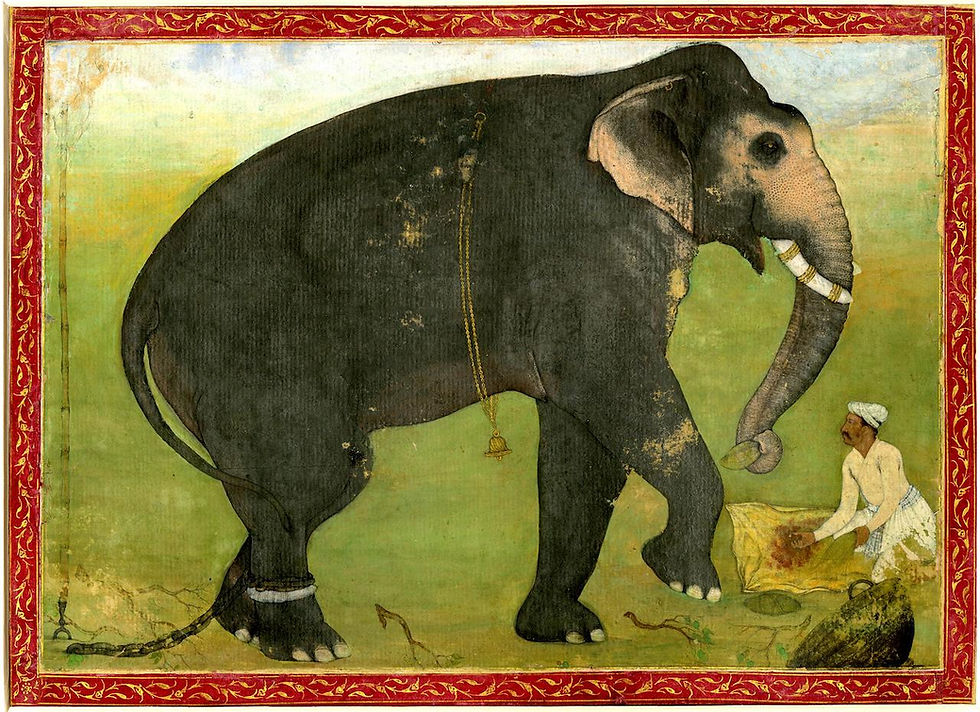
In the Jahangirnama, he repeatedly records encounters with unusual animals, as well as domesticated animals, and treats observation as a form of authority. However, the taste for naturalism was also political. Realistic depiction worked like imperial control. It implied that the court did not only possess land and wealth; it possessed knowledge. It could catalogue the living world with a steady gaze and present that gaze as refinement.
There was also an artistic context that made this precision possible. European artworks circulated at Mughal courts through diplomacy and trade, and institutions like the Victoria and Albert Museum assert that Mughal naturalism, especially under Jahangir, is often discussed alongside exposure to European modes of lifelike representation. This did not replace Mughal aesthetics. It expanded the toolkit and sharpened an existing appetite for detail.
Seen together, these paintings are not simply beautiful studies of feathers and fur. They are a kind of Mughal statecraft in miniature. The court is saying: we have seen it, we understand it, we can render it. And by rendering it, we can keep it.


Comments